
• Cart
    • Quote
    • Enquiry
    • Cart
    • Quote
    • Enquiry
Novogene Europe
  • Novogene Europe
  • Genomics
    • Human Whole Genome Sequencing
    • Whole Exome Sequencing
    • Plant and Animal Whole Genome Sequencing
    • Plant and Animal De novo Sequencing
    • Microbial Whole Genome Sequencing
    • Microbial De novo Sequencing
    • Whole Plasmid SequencingOrder Online!
    Proteomics
    • Olink ProteomicsNew!
    Epigenomics
    • DNA Methylation SequencingUpdated!
    • Chromatin Immunoprecipitation Sequencing (ChIP-seq)
    • RNA Immunoprecipitation Sequencing (RIP-seq)
    Metabolomics
    • Untargeted MetabolomicsNew!
    Transcriptomics
    • mRNA Sequencing
    • Small RNA Sequencing (sRNA‑seq)
    • Circular RNA Sequencing (circRNA-seq)
    • Total RNA Sequencing
    • Whole Transcriptome Sequencing
    • Full-Length Transcriptome Sequencing
    • Prokaryotic RNA Sequencing
    • Metatranscriptome Sequencing
    Metagenomics
    • Amplicon SequencingOrder Online!
    • Shotgun Metagenomics Sequencing
    Single Cell & Spatial Omics
    • 10x Single Cell Gene Expression
    • 10x Single Cell Immune Profiling
    • 10x Visium HD Spatial Gene Expression
    Premade Library
    • Sequencing Only on Illumina® Sequencer
    • Sequencing Only on Element SequencerNew!
    • Sequencing Only on PacBio Sequencer
    Translational Research
    • Accredited & Validated Clinical Research Sequencing
  • PromotionsPromotions
    • Platforms
    • Automated Delivery Platform (Falcon)
    • Bioinformatics Analysis Tool (NovoMagic)
    • Customer Service System (CSS)
    • Customer Support
    • Webinars
    • Case Study
    • Blog
    • Brochure
    • Cancer Research
    • Immuno-oncology
    • Agrigenomics
    • Environment
    • Food Science
    • Human Microbiome
    • Plant and Animal Microbiome
    • Drug Discovery and Development
    • Rare and Complex Diseases
    • About Us
    • News & Events
    • Careers
    • Our Locations
  • Contact UsContact Us
    • Amplicon Sequencing
    • Whole Plasmid Sequencing
  1. Home
  2. Resources
  3. Blog
  4. How to Choose the Right DNA Methylation Profiling Strategy

How to Choose the Right DNA Methylation Profiling Strategy

The same genome can produce very different biological outcomes, with DNA methylation providing an important layer of epigenetic regulation across development, disease and responses to the environment. There are now multiple ways to profile DNA methylation, from established bisulfite-based methods to enzymatic, non-bisulfite, and array-based approaches. However, the key decision is not which technology is newest, but what information the study needs to generate.

The biological question, sample characteristics, required genomic context and downstream analysis should therefore guide the choice of strategy.

Start with the biological question

Discovery studies may require genome-wide, single-base-resolution profiling, while others focus on CpG-rich regulatory regions, such as CpG islands and promoters, where targeted analysis may provide sufficient information without whole-genome coverage.

The question may also extend beyond methylation itself. Studies investigating relationships between genetic variation and epigenetic regulation can benefit from retaining genomic information alongside methylation status, whereas large cohorts may require consistent measurement of predefined CpG sites. Defining the biological objective first can therefore narrow the technology choices before practical considerations are introduced.

Consider the sample before the technology

Sample quantity and quality can significantly influence method selection because, although traditional bisulfite conversion enables single-base methylation analysis, it can fragment DNA and reduce sequence complexity. These are important considerations when starting material is limited, degraded or already fragmented.[1]

Enzymatic and other non-bisulfite approaches avoid harsh bisulfite treatment, and recent research has shown that enzymatic conversion can reduce fragmentation and improve library yield while producing methylation measurements comparable with bisulfite-based approaches.[1] Bisulfite conversion nevertheless remains a well-validated approach with mature analysis pipelines, and is a dependable choice for samples that meet the workflow input requirements.

Decide how much genomic context you need

Another key distinction is whether the study needs methylation information alone, or the underlying genomic sequence as well. Bisulfite conversion reduces sequence complexity through conversion of unmethylated cytosines, whereas non-bisulfite approaches can preserve sequence complexity, which may be valuable when investigating relationships between methylation and genetic variation. In these studies, the ability to examine genetic and epigenetic signals together can provide additional biological context.[2,3,5]

Think about downstream interpretation early

Generating a methylation profile is rarely the endpoint. Downstream analysis may include identifying differentially methylated regions (DMRs), functional annotation or enrichment analysis to investigate their biological significance.

Methylation can also form part of a wider multi-omics strategy, integrating genomics and transcriptomics to connect genetic variation and epigenetic regulation with downstream gene expression. Considering these requirements during study design helps ensure the data support the intended biological interpretation.

Match the strategy to the study

Once the biological question, sample characteristics, required genomic context and downstream analysis are defined, the relative strengths and trade-offs of each approach become clearer.

For comprehensive whole-methylome discovery, Whole-Genome Bisulfite Sequencing (WGBS) remains an established approach, providing genome-wide methylation profiling at single-base resolution. Its breadth requires substantial sequencing depth, while DNA fragmentation and loss during bisulfite conversion may be important considerations for low-input or degraded samples. Enzymatic methylation sequencing provides a comparable genome-wide, single-base view without harsh chemical conversion, making it particularly relevant where sample quantity or integrity is a concern.[1]

Where the research focus is primarily on CpG islands, promoters and other CpG-rich regulatory regions, Reduced Representation Bisulfite Sequencing (RRBS) enriches for these regions rather than profiling the whole genome. This can make it a more cost-effective option for larger sample numbers, although methylation outside the enriched regions is not comprehensively captured.

Studies requiring methylation and genomic information together may benefit from preserved-complexity approaches. TAPS+ avoids bisulfite conversion while preserving sequence complexity and supporting integrated methylation and genomic analysis (Figure 1).[2,5] It may also be suitable for challenging material such as FFPE DNA, depending on workflow input requirements and validated performance. Like standard WGBS and enzymatic methylation sequencing workflows, TAPS+ does not distinguish between 5mC and 5hmC in its methylation readout. By contrast, 5-base sequencing directly detects 5mC while preserving genomic information, enabling methylation and genomic variants to be analysed together.[3] The choice therefore depends on the methylation signal required, sample type and downstream genomic analysis.
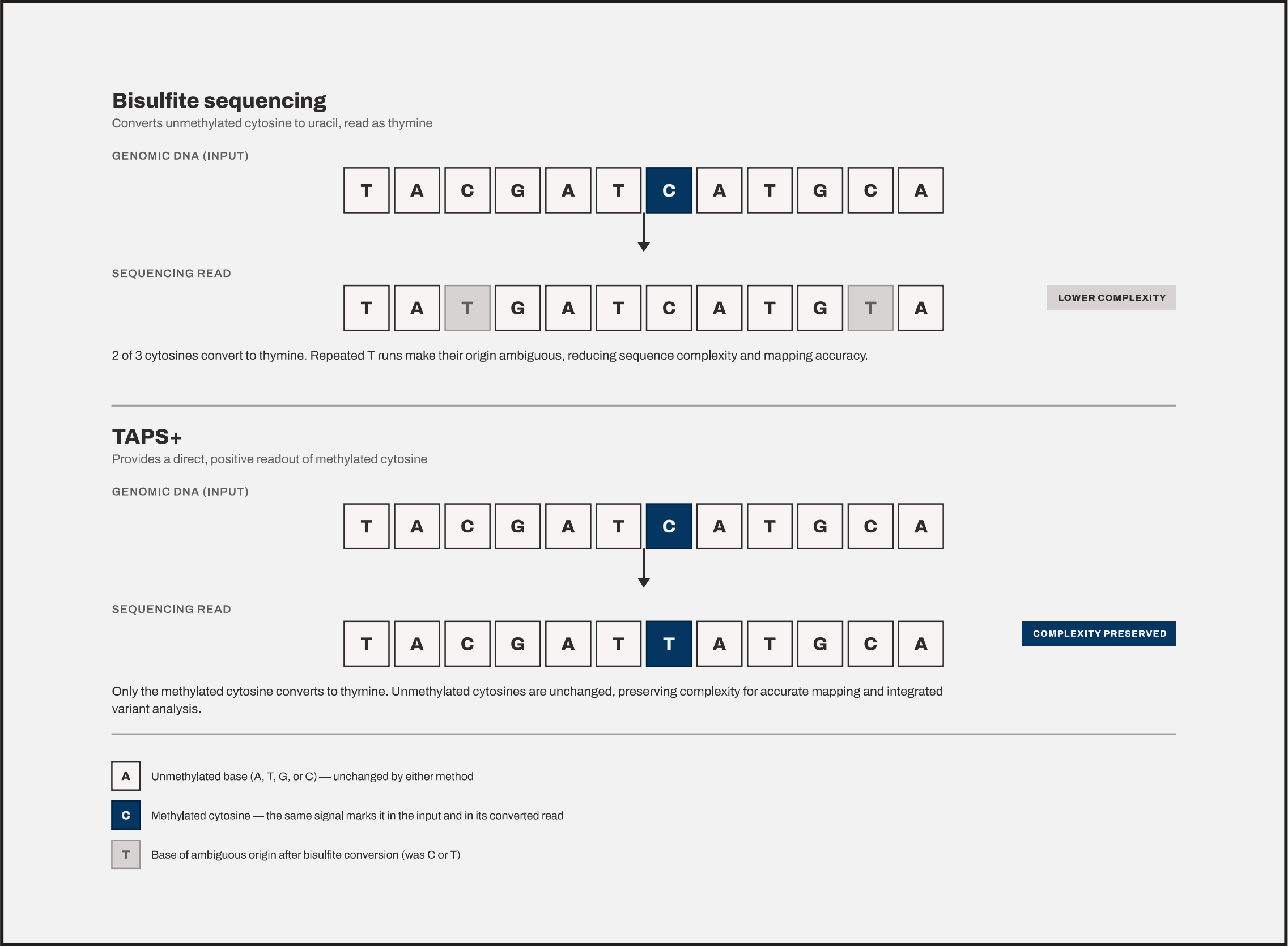
Comparison of bisulfite sequencing and TAPS+ showing preservation of sequence complexity

Figure 1. Preservation of sequence complexity in TAPS+ methylation sequencing.

For large human or mouse cohorts where consistent measurement of predefined CpG sites is more important than genome-wide discovery, array-based profiling provides a standardised and scalable alternative. The trade-off is genomic flexibility, as analysis is restricted to the CpG sites represented on the array.[6,7]
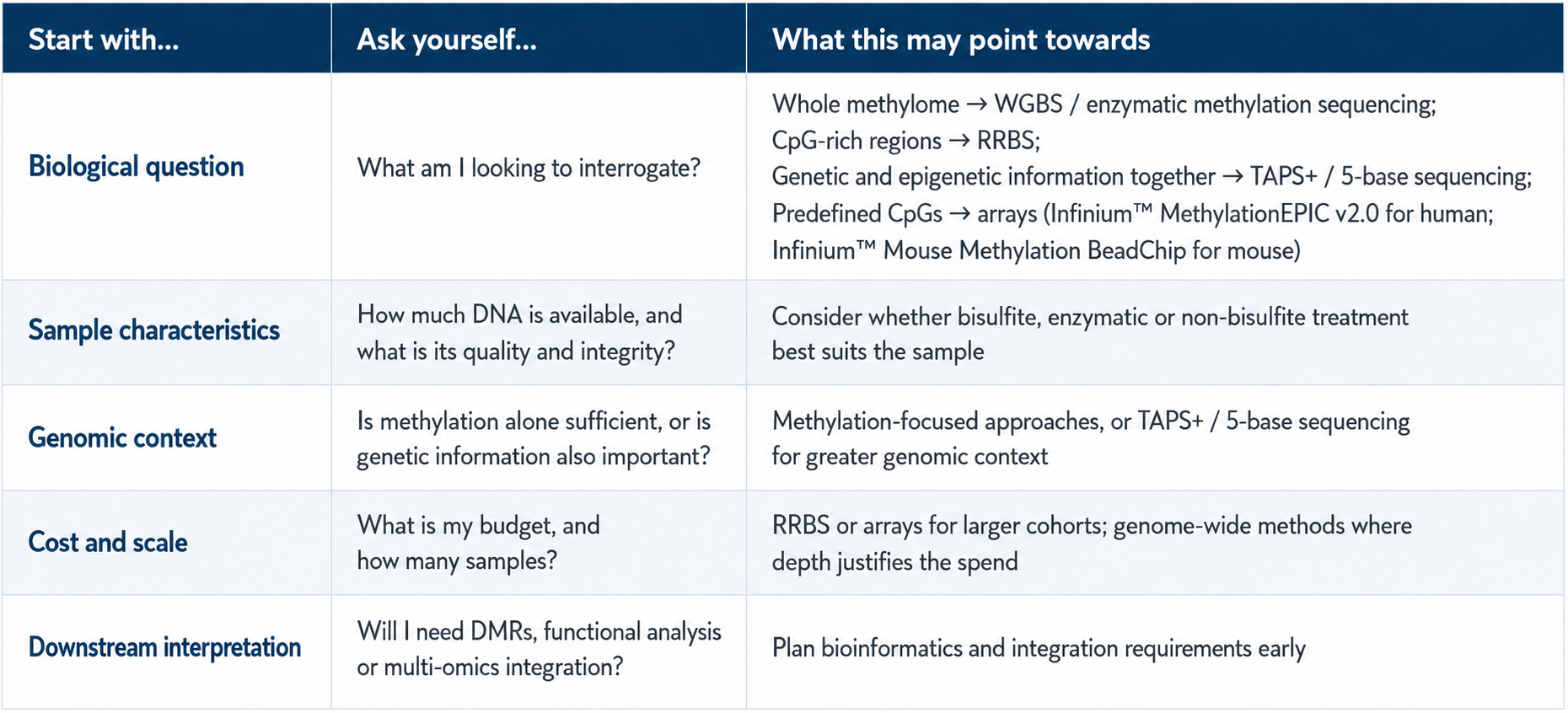
Table comparing DNA methylation profiling strategies

Table 1. Choosing a DNA methylation profiling strategy. Method selection should consider the biological question, sample characteristics, required genomic context, study scale and intended downstream analysis.

No single technology fits every methylation study. The most appropriate strategy is one that aligns the method to the biological question, the samples available, the genomic context required and the analysis planned. Novogene Europe supports DNA methylation study design, sequencing and downstream bioinformatics, including methylation profiling, DMR and functional analysis, with opportunities to integrate epigenomic data into broader multi-omics studies.[4]

Planning a methylation study? Talk to the Novogene Europe team to find the workflow that fits your samples, question and analysis goals.

References
  1. Nuttall B, Karl DL, Burke K, et al. Comprehensive comparison of enzymatic and bisulfite DNA methylation analysis in clinically relevant samples. Clinical Epigenetics. 2025;17:156. https://link.springer.com/article/10.1186/s13148-025-01959-0
  2. Holden KA, Fitzgerald KD, Shafi A, et al. Utility of TAPS+: a positive-readout methylation sequencing approach for high-fidelity epigenetic profiling. Cancer Research. 2026;86 (7_Supplement): 3213. https://aacrjournals.org/cancerres/article/86/7_Supplement/3213/779195/Abstract-3213-Utility-of-TAPS-a-positive-readout
  3. Illumina. DNA methylation and 5-base sequencing technologies. https://emea.illumina.com/techniques/sequencing/methylation-sequencing.html
  4. Novogene Europe. DNA Methylation Sequencing Services. https://eu.novogene.com/services/epigenomics/dna-methylation-sequencing
  5. Liu Y, Siejka-Zielińska P, Velikova G, et al. Bisulfite-free direct detection of 5-methylcytosine and 5-hydroxymethylcytosine at base resolution. Nature Biotechnology. 2019;37:424–429. https://pubmed.ncbi.nlm.nih.gov/30804537/
  6. Illumina. Infinium™ MethylationEPIC v2.0 BeadChip. https://www.illumina.com/products/by-type/microarray-kits/infinium-methylation-epic.html
  7. Illumina. Infinium™ Mouse Methylation BeadChip. https://www.illumina.com/products/by-type/microarray-kits/infinium-mouse-methylation.html

ServicesServices menu

ResourcesResources menu

SupportSupport menu

CompanyCompany menu

Services
Human Whole Genome SequencingWhole Exome SequencingPlant and Animal Whole Genome SequencingPlant and Animal De novo SequencingDNA Methylation SequencingmRNA SequencingFull-Length Transcriptome SequencingWhole Transcriptome SequencingMetatranscriptome SequencingShotgun Metagenomics SequencingAmplicon SequencingWhole Plasmid Sequencing10X Single Cell Gene Expression10X Single Cell Immune Profiling10X Visium HD Spatial Gene ExpressionOlink ProteomicsUntargeted MetabolomicsAccredited & Validated Clinical Research Sequencing
Resources
WebinarsCase StudyBlogBrochure
Support
PlatformBioinformatics Analysis Tool (NovoMagic)Customer Service System (CSS)Customer Support
Company
About UsNews & EventsLocationContact Us
LinkedInLinkedIn hoverYouTubeYouTube hoverInstagramInstagram hoverXX hover
Copyright © 2026 Novogene Inc. All rights reserved.For Research Use Only. Not for Clinical Diagnostic Use.
    • Cart
    • Quote
    • Enquiry
    • Cart
    • Quote
    • Enquiry
Novogene Europe
  • Novogene Europe
  • Genomics
    • Human Whole Genome Sequencing
    • Whole Exome Sequencing
    • Plant and Animal Whole Genome Sequencing
    • Plant and Animal De novo Sequencing
    • Microbial Whole Genome Sequencing
    • Microbial De novo Sequencing
    • Whole Plasmid SequencingOrder Online!
    Proteomics
    • Olink ProteomicsNew!
    Epigenomics
    • DNA Methylation SequencingUpdated!
    • Chromatin Immunoprecipitation Sequencing (ChIP-seq)
    • RNA Immunoprecipitation Sequencing (RIP-seq)
    Metabolomics
    • Untargeted MetabolomicsNew!
    Transcriptomics
    • mRNA Sequencing
    • Small RNA Sequencing (sRNA‑seq)
    • Circular RNA Sequencing (circRNA-seq)
    • Total RNA Sequencing
    • Whole Transcriptome Sequencing
    • Full-Length Transcriptome Sequencing
    • Prokaryotic RNA Sequencing
    • Metatranscriptome Sequencing
    Metagenomics
    • Amplicon SequencingOrder Online!
    • Shotgun Metagenomics Sequencing
    Single Cell & Spatial Omics
    • 10x Single Cell Gene Expression
    • 10x Single Cell Immune Profiling
    • 10x Visium HD Spatial Gene Expression
    Premade Library
    • Sequencing Only on Illumina® Sequencer
    • Sequencing Only on Element SequencerNew!
    • Sequencing Only on PacBio Sequencer
    Translational Research
    • Accredited & Validated Clinical Research Sequencing
  • PromotionsPromotions
    • Platforms
    • Automated Delivery Platform (Falcon)
    • Bioinformatics Analysis Tool (NovoMagic)
    • Customer Service System (CSS)
    • Customer Support
    • Webinars
    • Case Study
    • Blog
    • Brochure
    • Cancer Research
    • Immuno-oncology
    • Agrigenomics
    • Environment
    • Food Science
    • Human Microbiome
    • Plant and Animal Microbiome
    • Drug Discovery and Development
    • Rare and Complex Diseases
    • About Us
    • News & Events
    • Careers
    • Our Locations
  • Contact UsContact Us
    • Amplicon Sequencing
    • Whole Plasmid Sequencing
  1. Home
  2. Resources
  3. Blog
  4. How to Choose the Right DNA Methylation Profiling Strategy

How to Choose the Right DNA Methylation Profiling Strategy

The same genome can produce very different biological outcomes, with DNA methylation providing an important layer of epigenetic regulation across development, disease and responses to the environment. There are now multiple ways to profile DNA methylation, from established bisulfite-based methods to enzymatic, non-bisulfite, and array-based approaches. However, the key decision is not which technology is newest, but what information the study needs to generate.

The biological question, sample characteristics, required genomic context and downstream analysis should therefore guide the choice of strategy.

Start with the biological question

Discovery studies may require genome-wide, single-base-resolution profiling, while others focus on CpG-rich regulatory regions, such as CpG islands and promoters, where targeted analysis may provide sufficient information without whole-genome coverage.

The question may also extend beyond methylation itself. Studies investigating relationships between genetic variation and epigenetic regulation can benefit from retaining genomic information alongside methylation status, whereas large cohorts may require consistent measurement of predefined CpG sites. Defining the biological objective first can therefore narrow the technology choices before practical considerations are introduced.

Consider the sample before the technology

Sample quantity and quality can significantly influence method selection because, although traditional bisulfite conversion enables single-base methylation analysis, it can fragment DNA and reduce sequence complexity. These are important considerations when starting material is limited, degraded or already fragmented.[1]

Enzymatic and other non-bisulfite approaches avoid harsh bisulfite treatment, and recent research has shown that enzymatic conversion can reduce fragmentation and improve library yield while producing methylation measurements comparable with bisulfite-based approaches.[1] Bisulfite conversion nevertheless remains a well-validated approach with mature analysis pipelines, and is a dependable choice for samples that meet the workflow input requirements.

Decide how much genomic context you need

Another key distinction is whether the study needs methylation information alone, or the underlying genomic sequence as well. Bisulfite conversion reduces sequence complexity through conversion of unmethylated cytosines, whereas non-bisulfite approaches can preserve sequence complexity, which may be valuable when investigating relationships between methylation and genetic variation. In these studies, the ability to examine genetic and epigenetic signals together can provide additional biological context.[2,3,5]

Think about downstream interpretation early

Generating a methylation profile is rarely the endpoint. Downstream analysis may include identifying differentially methylated regions (DMRs), functional annotation or enrichment analysis to investigate their biological significance.

Methylation can also form part of a wider multi-omics strategy, integrating genomics and transcriptomics to connect genetic variation and epigenetic regulation with downstream gene expression. Considering these requirements during study design helps ensure the data support the intended biological interpretation.

Match the strategy to the study

Once the biological question, sample characteristics, required genomic context and downstream analysis are defined, the relative strengths and trade-offs of each approach become clearer.

For comprehensive whole-methylome discovery, Whole-Genome Bisulfite Sequencing (WGBS) remains an established approach, providing genome-wide methylation profiling at single-base resolution. Its breadth requires substantial sequencing depth, while DNA fragmentation and loss during bisulfite conversion may be important considerations for low-input or degraded samples. Enzymatic methylation sequencing provides a comparable genome-wide, single-base view without harsh chemical conversion, making it particularly relevant where sample quantity or integrity is a concern.[1]

Where the research focus is primarily on CpG islands, promoters and other CpG-rich regulatory regions, Reduced Representation Bisulfite Sequencing (RRBS) enriches for these regions rather than profiling the whole genome. This can make it a more cost-effective option for larger sample numbers, although methylation outside the enriched regions is not comprehensively captured.

Studies requiring methylation and genomic information together may benefit from preserved-complexity approaches. TAPS+ avoids bisulfite conversion while preserving sequence complexity and supporting integrated methylation and genomic analysis (Figure 1).[2,5] It may also be suitable for challenging material such as FFPE DNA, depending on workflow input requirements and validated performance. Like standard WGBS and enzymatic methylation sequencing workflows, TAPS+ does not distinguish between 5mC and 5hmC in its methylation readout. By contrast, 5-base sequencing directly detects 5mC while preserving genomic information, enabling methylation and genomic variants to be analysed together.[3] The choice therefore depends on the methylation signal required, sample type and downstream genomic analysis.

Comparison of bisulfite sequencing and TAPS+ showing preservation of sequence complexity

Figure 1. Preservation of sequence complexity in TAPS+ methylation sequencing.

For large human or mouse cohorts where consistent measurement of predefined CpG sites is more important than genome-wide discovery, array-based profiling provides a standardised and scalable alternative. The trade-off is genomic flexibility, as analysis is restricted to the CpG sites represented on the array.[6,7]

Table comparing DNA methylation profiling strategies

Table 1. Choosing a DNA methylation profiling strategy. Method selection should consider the biological question, sample characteristics, required genomic context, study scale and intended downstream analysis.

No single technology fits every methylation study. The most appropriate strategy is one that aligns the method to the biological question, the samples available, the genomic context required and the analysis planned. Novogene Europe supports DNA methylation study design, sequencing and downstream bioinformatics, including methylation profiling, DMR and functional analysis, with opportunities to integrate epigenomic data into broader multi-omics studies.[4]

Planning a methylation study? Talk to the Novogene Europe team to find the workflow that fits your samples, question and analysis goals.

References
  1. Nuttall B, Karl DL, Burke K, et al. Comprehensive comparison of enzymatic and bisulfite DNA methylation analysis in clinically relevant samples. Clinical Epigenetics. 2025;17:156. https://link.springer.com/article/10.1186/s13148-025-01959-0
  2. Holden KA, Fitzgerald KD, Shafi A, et al. Utility of TAPS+: a positive-readout methylation sequencing approach for high-fidelity epigenetic profiling. Cancer Research. 2026;86 (7_Supplement): 3213. https://aacrjournals.org/cancerres/article/86/7_Supplement/3213/779195/Abstract-3213-Utility-of-TAPS-a-positive-readout
  3. Illumina. DNA methylation and 5-base sequencing technologies. https://emea.illumina.com/techniques/sequencing/methylation-sequencing.html
  4. Novogene Europe. DNA Methylation Sequencing Services. https://eu.novogene.com/services/epigenomics/dna-methylation-sequencing
  5. Liu Y, Siejka-Zielińska P, Velikova G, et al. Bisulfite-free direct detection of 5-methylcytosine and 5-hydroxymethylcytosine at base resolution. Nature Biotechnology. 2019;37:424–429. https://pubmed.ncbi.nlm.nih.gov/30804537/
  6. Illumina. Infinium™ MethylationEPIC v2.0 BeadChip. https://www.illumina.com/products/by-type/microarray-kits/infinium-methylation-epic.html
  7. Illumina. Infinium™ Mouse Methylation BeadChip. https://www.illumina.com/products/by-type/microarray-kits/infinium-mouse-methylation.html

ServicesServices menu

ResourcesResources menu

SupportSupport menu

CompanyCompany menu

Services
Human Whole Genome SequencingWhole Exome SequencingPlant and Animal Whole Genome SequencingPlant and Animal De novo SequencingDNA Methylation SequencingmRNA SequencingFull-Length Transcriptome SequencingWhole Transcriptome SequencingMetatranscriptome SequencingShotgun Metagenomics SequencingAmplicon SequencingWhole Plasmid Sequencing10X Single Cell Gene Expression10X Single Cell Immune Profiling10X Visium HD Spatial Gene ExpressionOlink ProteomicsUntargeted MetabolomicsAccredited & Validated Clinical Research Sequencing
Resources
WebinarsCase StudyBlogBrochure
Support
PlatformBioinformatics Analysis Tool (NovoMagic)Customer Service System (CSS)Customer Support
Company
About UsNews & EventsLocationContact Us
LinkedInLinkedIn hoverYouTubeYouTube hoverInstagramInstagram hoverXX hover
Copyright © 2026 Novogene Inc. All rights reserved.For Research Use Only. Not for Clinical Diagnostic Use.
Privacy PolicyCookie PolicyTerms