
Novogene selected as Next Generation Sequencing partner for space-bound Lucky Clover project.
The “Glücksklee” Project, translated as the Lucky Clover Project, came about when the German and Luxembourg Space Agencies announced the Uberflieger 2 programme, a call for experiments that could be carried out on the International Space Station (ISS) and make use of the unique conditions there, such as zero gravity or increased radiation. Four teams were selected to have their experiment launched to the ISS, and among them was a group of 10 students from Leibniz University Hannover in Germany. The team is a multidisciplinary melting pot, with students from plant biotechnology, biochemistry, mechanical engineering, computer science, horticulture, and plant cultivation backgrounds, all required to bring their vision to life.
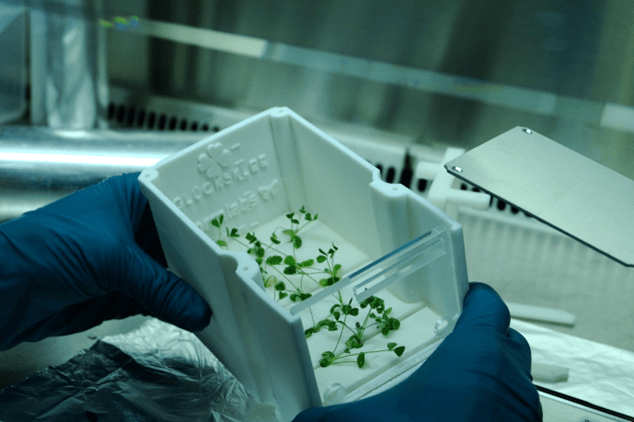
The aim of the experiment is to study the effects of zero gravity on the symbiosis between the plant Medicago truncatula and the root bacteria Sinorhizobium meliloti. S. meliloti and M. trunculata have a symbiotic relationship whereby S. meliloti forms nodules in the root of M. trunculata and fixes nitrogen for the plant. In turn, S. meliloti receives sugars from M.trunculata.
The experiment required input from all disciplines represented in the team to design a box containing a biological unit and an electronic unit. The biological unit will house thirteen M. trunculata seedlings along with a nutrient media and light source to support growth. The electronic unit will house components such as a camera and various sensors to monitor requirements such as temperature, carbon dioxide levels, light, and humidity. All of these components will be controlled from the ground while the experiment is on board the ISS.
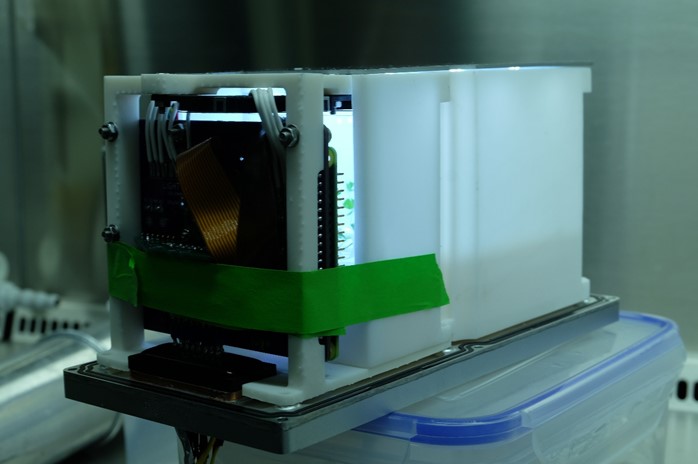
The experiment is due to be launched from Florida to the ISS aboard the SpaceX 27 rocket on the 10th of March. Speaking with Pia Bensch and Nils Wörz, two plant biotechnology Masters students on the team, we learned there is still some preparation to do, and the final steps are underway. “We have started germinating the M. trunculata seeds, so they’ll be 2-3 weeks old when they are launched to the ISS. The apparatus will be collected and shipped to the US on the 2nd of March, and we will travel to the US to assemble the experiment on the 5th of March.”
When asked what their predictions are, Pia said “I think we might see a change in overall levels of RNA, whether levels will be higher or lower is difficult to say. There will likely be a downregulation of growth-related gene expression due to the stress the plants will be under, but then an increase in stress response gene expression. We are excited to see how well the plants will handle the stresses of space travel and zero gravity.”
Nils added “We know that roots normally grow in coiled formations in zero gravity which would make it difficult to form nodules. We are sending our plants up as 3-week-old seedlings that will have had time to form the necessary symbiotic nodules with their roots already established under normal gravity. The nodule formation will be initiated on earth, and we hope to see full development of the nodules during the 40-day experiment on board the ISS. And of course, the aim of the experiment is to assess the effects of zero gravity on the root symbiosis, so we are hoping to see changes in expression levels of genes involved in this symbiosis compared to our control experiments on the ground.”
Novogene’s RNA sequencing services will be called upon after the experiment is returned to earth, frozen at -80°C, and the RNA has been extracted. We will provide data to compare the expression profiles of M. trunculata and S. meliloti from the ISS experiment and the control experiments to assess the impact of zero gravity on the symbiotic relationship between the species. We are looking forward to getting the samples!